

Insights
News, commentary and market perspectives from Anglo-Suisse Capital.
Our insights page brings together firm updates, market commentary and selected perspectives relevant to cross-border M&A, capital raising and secondary transactions.

- Details
- Written by: Charles Hancock
- Category: News
- Read Time: 5 mins
Strategic alliance with Jaeros Capital Advisors and three Switzerland-based senior appointments extend the firm’s coverage of Swiss and DACH institutional investors.
London and Zurich, 24 August 2026 – Anglo-Suisse Capital, the London-based independent investment banking firm, today announces a significant strengthening of its presence in Switzerland through a strategic alliance with Jaeros Capital Advisors, a Swiss capital advisory firm, and the appointment of three Switzerland-based Senior Advisers.
The alliance brings together complementary origination, investor coverage and execution capabilities across private market mandates. It combines Anglo-Suisse Capital’s cross-border transaction expertise in M&A advisory and capital solutions with the Swiss platform and home-market institutional expertise of Jaeros Capital Advisors, built on long-standing Swiss investor coverage and distribution experience. Clients gain a fully integrated service across the transaction lifecycle from mandate origination through investor engagement to completion.
As part of the alliance, Jeremy Baker and Silvia Graemiger of Jaeros Capital Advisors will also serve as Senior Advisers to Anglo-Suisse Capital while continuing their work through Jaeros.
Separately from the alliance, Nicolaj Waldorf Christensen joins Anglo-Suisse Capital as a Switzerland-based Senior Adviser. Nicolaj is not affiliated with Jaeros Capital Advisors.
Coverage now extends to institutional investors, family offices and wealth managers across Switzerland and the wider DACH region, alongside Anglo-Suisse Capital’s established reach across the United Kingdom, continental Europe, the Middle East and North America. The expansion gives practical expression to the firm’s Anglo-Swiss name and heritage.
Silvia Graemiger will act as Senior Adviser and leads capital raising and structuring for Swiss institutional investors. Based in Zug, she has built a career spanning commercial leadership, institutional business development, relationship management and governance, with long-standing connections to senior allocators and family offices across Switzerland and the DACH region.
Jeremy Baker will act as Senior Adviser covering real assets, real estate, digital infrastructure and commodities. Based in Zurich, he is Managing Director of Jaeros Capital Advisors and brings a strong record in mandate origination, investor positioning and transaction delivery, most recently across European data centre and digital infrastructure capital raisings.
Nicolaj Waldorf Christensen is appointed as Senior Adviser for Anglo-Suisse Capital in Switzerland, focussing on M&A and strategic advisory services. His background spans transformation, value creation, M&A, post-merger integration and commercial due diligence for leading European businesses. He is a Board Member of the Danish-Swiss Chamber of Commerce and an Advisory Board Member of the Advanced AI Society in the United States. He brings strategic operating experience, cross-border advisory judgement and an extensive European business network to the firm.
What this means for clients and investors
- Broader coverage and distribution through coordinated outreach across the United Kingdom, Switzerland, continental Europe, the Middle East and North America.
- Additional execution capacity to maintain momentum and transaction discipline.
- Integrated advisory capability spanning M&A, capital raises, refinancings and structured financing.
Charles Hancock, Chief Executive of Anglo-Suisse Capital, said:
“Switzerland is in our name and in our history. This expansion is straightforward in its intent: broaden our reach into Switzerland and the DACH region, bring in people who know the market and hold to the discipline that delivers consistent outcomes on the mandates we take on. Silvia, Jeremy and Nicolaj each add depth exactly where our clients need it.”
Jeremy Baker, Managing Director of Jaeros Capital Advisors, said:
“Combining our Swiss institutional coverage with Anglo-Suisse Capital’s international execution platform gives clients a genuinely integrated service, from origination through investor engagement to closing.”
Notes to editors
About Anglo-Suisse Capital
Anglo-Suisse Capital Limited is an independent investment banking firm providing M&A advisory, capital raising and strategic advisory across private markets, serving clients across the United Kingdom, Europe, the Middle East and the United States. The firm is headquartered at 168 Fulham Road, London SW10 9PR. Further information is available at anglo-suisse.com.
About Jaeros Capital Advisors
Jaeros Capital Advisors is an independent Swiss advisory and capital-raising firm supporting sponsors, platforms and investors across real assets and private market strategies. Further information is available at jaerosca.com.
Media enquiries
Anglo-Suisse Capital
Charles Hancock, Chief Executive
Jaeros Capital Advisors
Jeremy Baker, Managing Director
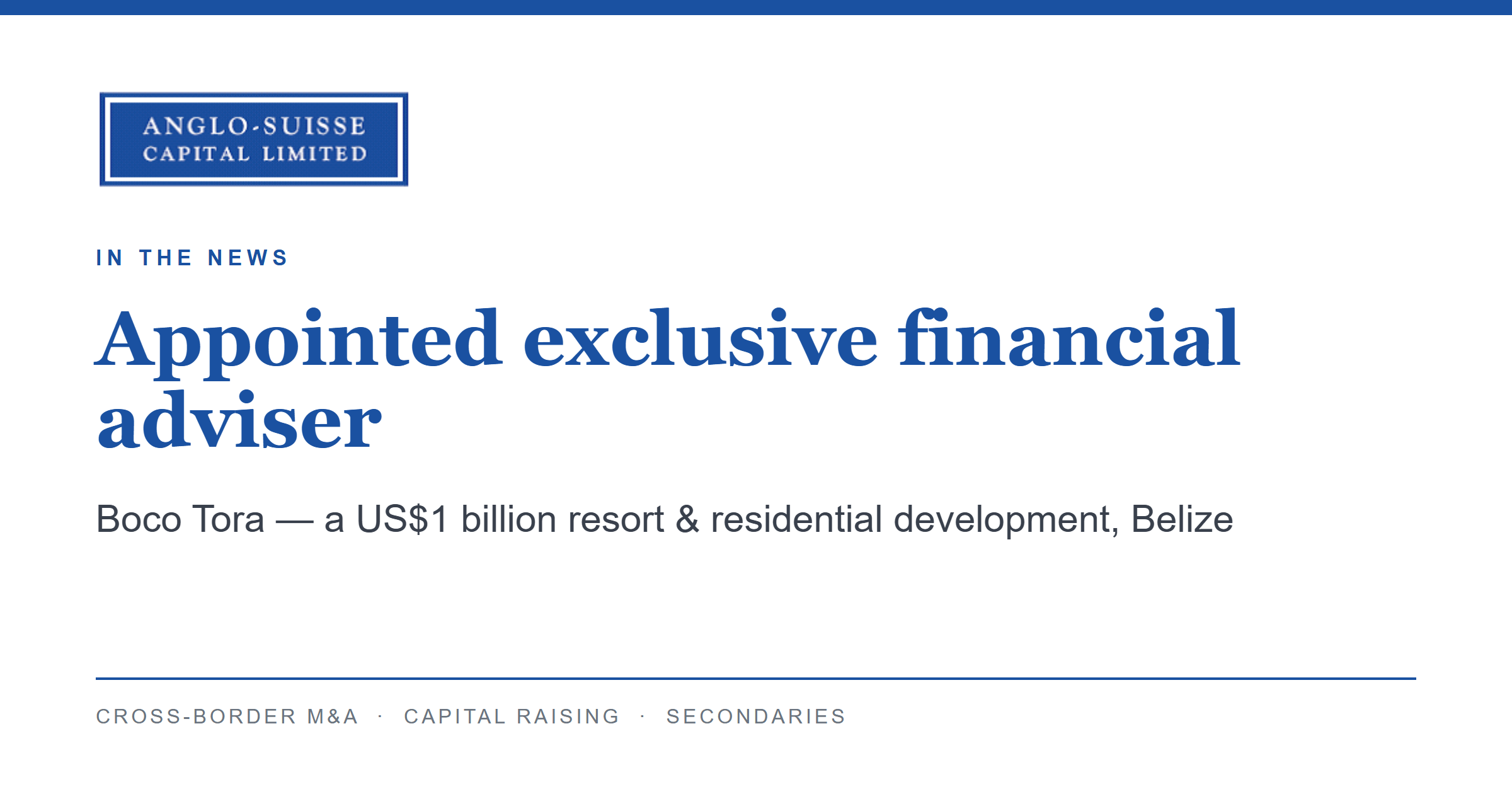
Advanced Green Holdings, Inc. has announced the appointment of Anglo-Suisse Capital as exclusive financial adviser in connection with the proposed financing of Boco Tora, a US$1 billion luxury eco-resort and branded residential development planned across three sites in Belize.
The announcement was issued by Advanced Green Holdings and is available in full via PR Newswire:
Capital raising works best when the issuer can explain use of proceeds, valuation logic, evidence of demand, governance and timing before investor outreach starts.
In private markets, weak preparation usually shows quickly. Investors, buyers and boards expect clear materials, consistent answers and a process that respects confidentiality.
Practical questions
- What is the precise use of proceeds?
- What evidence supports the valuation or target raise?
- Which investors are genuinely relevant?
- What diligence materials are ready now?
- Who will answer detailed investor questions?
Anglo-Suisse view
A smaller number of well-prepared conversations will usually be more effective than broad outreach with unfinished materials. The objective is to create credible dialogue with counterparties who understand the situation and can act.
Private market secondary transactions require a careful balance between confidentiality, buyer qualification and market-tested pricing.
In private markets, weak preparation usually shows quickly. Investors, buyers and boards expect clear materials, consistent answers and a process that respects confidentiality.
Practical questions
- Define the asset and the transfer restrictions.
- Identify buyers who can complete, not just express interest.
- Stage disclosure so sensitive information is protected.
- Use a disciplined process to compare price, timing and certainty.
Anglo-Suisse view
A smaller number of well-prepared conversations will usually be more effective than broad outreach with unfinished materials. The objective is to create credible dialogue with counterparties who understand the situation and can act.
- Details
- Read Time: 3 mins
Cross-border M&A processes reward preparation. A buyer, seller or shareholder group that approaches the market with clean information, a clear mandate and realistic execution discipline will usually move faster, protect confidentiality better and create more competitive tension.
Before appointing an investment bank, the company should be able to explain the objective of the process in one sentence. The objective may be a full sale, majority recapitalisation, minority growth-capital transaction, joint venture, acquisition search or strategic investor introduction. If the objective is vague, the adviser will spend early time resolving issues that should already have been settled by the board or shareholder group.
The second requirement is a reliable financial pack. At minimum, this should include audited accounts where available, current management accounts, a bridge from statutory numbers to management presentation, revenue analysis by product or customer group, gross margin analysis, working-capital movements, debt schedule and any normalisation adjustments. Buyers and investors do not need perfection at the first conversation, but they do need consistency. Inconsistent numbers weaken credibility and slow diligence.
The third requirement is a clean explanation of ownership and authority. Cross-border transactions often involve holding companies, subsidiaries, founder shareholders, family trusts, investor consents and jurisdiction-specific approvals. The company should identify who can approve a mandate, who can approve exclusivity, who can approve signing and whether any third-party consent may be needed.
The fourth requirement is a concise investment story. The best materials do not overwhelm readers with every detail. They explain the market, the company's position, the reason now is the right time for a transaction, the growth levers and the risks that sophisticated counterparties will test. A credible story includes both opportunity and constraint. It should not sound like marketing copy.
The fifth requirement is a realistic buyer or investor universe. Cross-border M&A is not only about identifying names. It is about ranking likely interest, strategic fit, decision makers, prior acquisition behaviour, regulatory issues, financing capacity and cultural fit. A focused list of credible counterparties is more useful than a long list of names without a reason to engage.
The sixth requirement is confidentiality discipline. The company should decide which materials can be shared before a non-disclosure agreement, which materials require an NDA, which materials should remain in a controlled data room and who inside the business will know about the process. Leaks can damage staff morale, customer confidence and negotiating leverage.
The seventh requirement is management availability. A serious process needs fast responses. If management cannot answer diligence questions, attend calls or update forecasts during the process, momentum will suffer. The company should agree an internal process team before launch.
The eighth requirement is regulatory and legal readiness. Cross-border transactions can involve foreign investment reviews, sanctions screening, competition analysis, sector approvals, data-transfer issues and financial-promotion controls. These issues should be mapped early, not discovered after a preferred counterparty has been selected.
The ninth requirement is alignment on valuation expectations. A board does not need to set a fixed price before appointing an adviser, but it should understand the valuation evidence it is likely to face. That evidence may include precedent transactions, listed comparables, private-market funding rounds, discounted cash flow analysis and buyer-specific synergy arguments.
The tenth requirement is a clear adviser brief. The company should decide whether it wants broad market access, a discreet targeted process, strategic buyer coverage, financial sponsor coverage, capital raising alongside M&A, secondary liquidity or a combination of these. A precise brief helps the adviser choose the right process and prevents wasted work.
Anglo-Suisse Capital advises companies, funds and professional investors on cross-border M&A, capital raising and secondary transactions across the UK, Europe, the Middle East and the United States. For boards considering a transaction, early preparation is often the difference between a controlled process and a reactive one.
- Details
- Read Time: 2 mins
In private market fundraising, the biggest advantage rarely comes from the longest investor list. It usually comes from sharper positioning, better materials and more disciplined outreach. In our view, focused processes tend to preserve management time, improve the quality of dialogue and create more credible momentum with serious counterparties.
There is a common assumption in fundraising that broader outreach automatically creates a better result. In practice, the opposite is often true. A process that tries to cover too many names too quickly can dilute the message, absorb management attention and make it harder to distinguish genuine investor interest from background noise.
That matters even more in private markets, where relationships, timing and process control often have a greater impact on outcomes than simple reach. If the proposition is not clearly framed and the investor universe is not properly prioritised, volume can become a distraction rather than an advantage.
Read more: Private market fundraising: why focus matters more than volume
More Articles …
- What does a placement agent do?
- What is a secondary transaction in private equity?
- Cross-border M&A: a practical guide
- Anglo-Suisse Capital welcomes Luis Phillips as Senior Consultant
- Beyond Beta: alpha-generating digital asset strategies
- Lionsoul Global releases three new products after investor survey